
Antiscalant Chemical for Chillers at Salalah Free Zone Plants
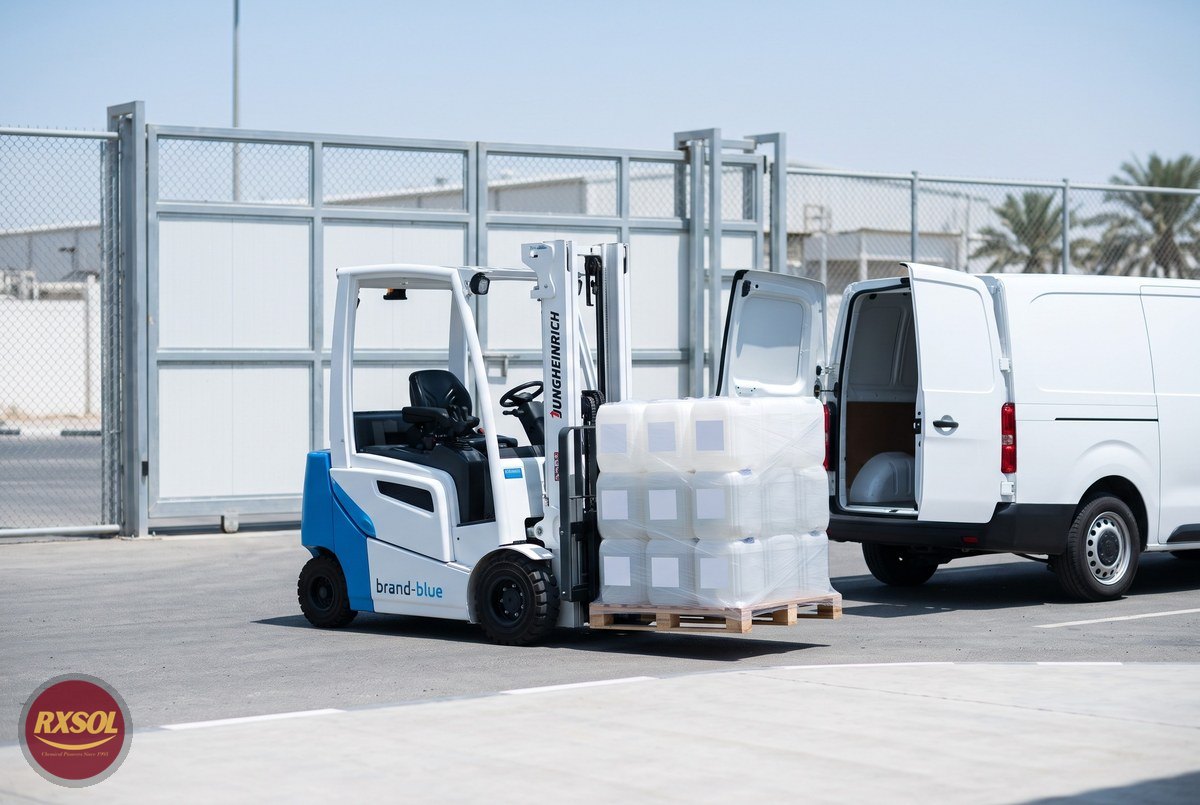
Scale and corrosion in the water circuits cut chiller capacity at Salalah Free Zone methanol, ammonia and cement plants. The usual fix is an antiscalant chemical for chillers combined with a corrosion inhibitor. We supply Anti Corrosion and Anti Scaler Chiller TRAC 109 (RXSOL-43-4301-109). It is a concentrated liquid that holds ferrous and non-ferrous corrosion inhibitors, antiscalants, a dispersant and a non-carbonate buffer in one container. It is made for closed chilled water loops and other closed cooling circuits, and we deliver it from our Barka warehouse to Salalah and across Dhofar.
What an antiscalant chemical for chillers does
An antiscalant slows the crystallisation of hardness salts, keeps fine particles dispersed and distorts crystals so they do not grip the metal. Most products in this class are based on phosphonic acid and sulfonic acid chemistry. Aminophosphonates and organic acids are also common.
In a chiller product the antiscalant works alongside a corrosion inhibitor. Combined anti-scale and anti-corrosion treatments are usually built on nitrite or molybdate inhibitors blended with anti-scaling agents. TRAC 109 is a nitrite-type blend, and you check its level in the loop with a standard RXSOL nitrite and chloride test kit. The low molecular weight polymers in the formulation inhibit calcium, magnesium and silica scale and disperse iron oxide, which also helps corrosion control. The product protects cast iron, mild steel and copper. It forms a stable protective microfilm against electrolytic corrosion, and because it is alkaline it suppresses the acid attack that would otherwise cause severe pitting.
Closed chilled water loop vs open condenser loop
Your chiller has two water circuits, and each needs its own treatment. The closed chilled water loop does not evaporate water, so its scaling risk is low. The main threats there are internal corrosion and black water. Closed loops are treated with a corrosion inhibitor package, sometimes with a biocide, and with glycol where freeze protection is needed.
The open condenser loop runs through a cooling tower. Towers concentrate dissolved minerals 3 to 5 times compared with make-up water. Condenser loops therefore need scale and corrosion inhibitors, controlled cycles of concentration, blowdown and a biocide programme.
A closed-loop product still carries an antiscalant because closed loops take on make-up water after leaks, drain-downs and repairs, and every top-up adds fresh hardness. The antiscalant keeps that hardness in solution so it does not settle on heat transfer surfaces, and the dispersant keeps existing iron oxide moving towards the filters. TRAC 109 belongs on the closed side. For the tower side, ask us for a dedicated cooling tower scale inhibitor from our cooling water chemical range.
Why chillers in Salalah and Dhofar need closer watching
Dhofar chillers work against heat for most of the year, and the humid khareef months add to the heat load on the condensers. Higher load means hotter condenser tubes and faster scaling on the open side. Warmer water also speeds up corrosion on the closed side, because corrosion rates rise with water temperature.
Scale on condenser tubes adds thermal resistance, which raises condensing temperature and energy use. Published vendor figures range from 12 to 15% heat-transfer loss for 1/16 inch of scale up to about 30% for 0.25 mm. On a large free zone process chiller that runs around the clock, the loss shows up as extra compressor power on every electricity bill.
Make-up water quality matters as well. Desalinated water and local groundwater differ in hardness and chloride, so a plant in Raysut using desalinated make-up may need a different treatment from an inland site on well water. Antiscalant selection depends on calcium, magnesium, barium, strontium, sulfate, carbonate alkalinity, silica, iron and pH. We ask for a water analysis before we recommend a product.
Chiller duty at free zone plants, cold stores and Salalah port
The methanol and ammonia plants in the Salalah Free Zone rely on chillers and closed circuits for process cooling, compressors and control buildings. Cement plants in Dhofar run closed circuits on compressors and DG sets. TRAC 109 is suitable for closed water cooling systems, compressor and heating cooling water circuits, chiller systems, radiators, DG sets and transformer cooling systems.
Fish processing plants and cold stores in Salalah run chillers and ice plants without a break during the fishing season. The product is also suitable for ice melting systems. A clean chilled water loop holds its design temperature with less compressor running time. At Salalah port, the same chemistry treats closed jacket water on diesel engines and generators.
Dosing guide: initial charge and top-up per 1,000 litres
The right dose depends on system size, construction materials and fluid condition, so take and analyse a sample of the system fluid before any remedial dosing. The initial dose for TRAC 109 is given in the technical datasheet, which is available on request. Send us your loop volume and we will size the first order from it.
For top-ups, a typical dose of about 0.15% of system volume for a nitrite-type product raises the inhibitor reserve by about 100 ppm. On a 1,000 litre loop that comes to about 1.5 litres. Test the inhibitor level before you top up instead of dosing by the calendar. With TRAC 109, keep the loop pH within the limit of 8.3 to 10.0. If a system is badly fouled with oil or scale, degrease or descale it before you add the treatment.
Testing the loop: nitrite reserve, pH, conductivity and coupons
Before you add chemical, record the pH, TDS and nitrite level. Dose, let the system circulate for a while, then check and record the readings again. Keep tracking them over time.
The trend tells you what is going on. If TDS and nitrite both drop, you have a leak or unknown make-up. If TDS stays stable and nitrite drops, you have a biological problem: bacteria are converting nitrite to nitrate. The fix is DI water for make-up and a biocide to control bacterial growth.
A full programme adds monthly closed-loop inhibitor checks, corrosion coupons reviewed quarterly, iron and copper analysis, and a laboratory analysis of the loop fluid about twice a year. On the open condenser side, check conductivity, pH, oxidant residual and the feed pump weekly.
Specifications, packing and safe handling
| Item | Detail |
|---|---|
| Part number | RXSOL-43-4301-109 |
| Product | Anti Corrosion and Anti Scaler Chiller TRAC 109 |
| Composition | Concentrated liquid with ferrous and non-ferrous corrosion inhibitors, antiscalants, dispersant and non-carbonate buffer |
| Application | Closed cooling water and chiller systems, radiators, DG sets, compressors, ice melting and transformer cooling systems |
| Metals protected | Cast iron, mild steel and copper |
| Dosage | Refer to technical datasheet |
| Control | Loop pH 8.3 to 10.0, nitrite and chloride checked with RXSOL test kit |
| Typical appearance (class) | Clear straw-coloured to brown, low-viscosity, low-foaming liquid |
| Packing | 5, 20, 35, 50, 210 Ltr |
| MSDS | On request |
Keep the safety data sheet, spill containment and personal protective equipment for treatment chemicals at the dosing point. The MSDS for TRAC 109 lists sodium nitrite as an ingredient, so follow its PPE and first aid sections when you handle the concentrate.
Where to buy antiscalant chemical for chillers in Salalah
Salalah Chemical (RXSOL group, Oman) supplies TRAC 109 from our Barka warehouse, with deliveries to Salalah and Dhofar, including the free zone, Raysut and Salalah port. The TRAC 109 chiller anti-scale and anti-corrosion product page has the full description. You can also browse all our water treatment and plant chemicals. If your company has plants in the north, the same part number is also listed on our Sohar site.
Call +968 77333599, message us on WhatsApp or email muscatchem@gmail.com. Send us your loop volume, the metals in the system, your make-up water source and a recent water analysis if you have one. We will reply with the dose, a suitable pack size and the MSDS.
Frequently asked questions
Do closed-loop chilled water systems need an antiscalant, or only a corrosion inhibitor?
The main need is a corrosion inhibitor, because closed loops do not evaporate water. An antiscalant is worth having where the loop takes regular make-up water or was filled with hard water, because it keeps hardness and iron oxide dispersed. TRAC 109 carries both.
Which is better for a chiller loop: nitrite-based or molybdate-based inhibitor?
Both passivate metal surfaces. Nitrite is easy to test on site with a nitrite kit. In our test work, sodium molybdate at 50-100 ppm gave the same corrosion inhibition as sodium nitrite at 800+ ppm, which keeps conductivity lower and reduces galvanic corrosion potential. If you prefer molybdate, ask us about our molybdate/phosphonate closed-loop inhibitor.
Can chiller anti-scale and anti-corrosion chemical be used with glycol?
Products in this class are typically compatible with glycol and alcohol antifreezes and with standard gaskets and seals. Give us the glycol type and concentration with your enquiry so we can confirm compatibility for your loop.
What causes black water in a chilled water system?
Black water comes from internal corrosion of steel in the loop, usually after the inhibitor reserve has run low. Test the loop, clean it if it is heavily fouled, then recharge the inhibitor. The dispersant in TRAC 109 helps keep iron oxide in suspension so your filters can remove it.
How often should chilled water be sampled and tested?
Check the closed-loop inhibitor level monthly, review corrosion coupons quarterly and send the loop fluid for a full analysis about twice a year. Retest after any leak, drain-down or large make-up.
To request a quote for TRAC 109, message us on WhatsApp at +968 77333599 or use our quote request page.
Frequently asked questions
Do closed-loop chilled water systems need an antiscalant, or only a corrosion inhibitor?
The main need is a corrosion inhibitor, because closed loops do not evaporate water. An antiscalant is worth having where the loop takes regular make-up water or was filled with hard water, because it keeps hardness and iron oxide dispersed. TRAC 109 carries both.
Which is better for a chiller loop: nitrite-based or molybdate-based inhibitor?
Both passivate metal surfaces. Nitrite is easy to test on site with a nitrite kit. In our test work, sodium molybdate at 50-100 ppm gave the same corrosion inhibition as sodium nitrite at 800+ ppm, which keeps conductivity lower and reduces galvanic corrosion potential. If you prefer molybdate, ask us about our molybdate/phosphonate closed-loop inhibitor.
Can chiller anti-scale and anti-corrosion chemical be used with glycol?
Products in this class are typically compatible with glycol and alcohol antifreezes and with standard gaskets and seals. Give us the glycol type and concentration with your enquiry so we can confirm compatibility for your loop.
What causes black water in a chilled water system?
Black water comes from internal corrosion of steel in the loop, usually after the inhibitor reserve has run low. Test the loop, clean it if it is heavily fouled, then recharge the inhibitor. The dispersant in TRAC 109 helps keep iron oxide in suspension so your filters can remove it.
How often should chilled water be sampled and tested?
Check the closed-loop inhibitor level monthly, review corrosion coupons quarterly and send the loop fluid for a full analysis about twice a year. Retest after any leak, drain-down or large make-up.