
Sodium Hypochlorite for Food Areas: Salalah Hotels and Fish Plants
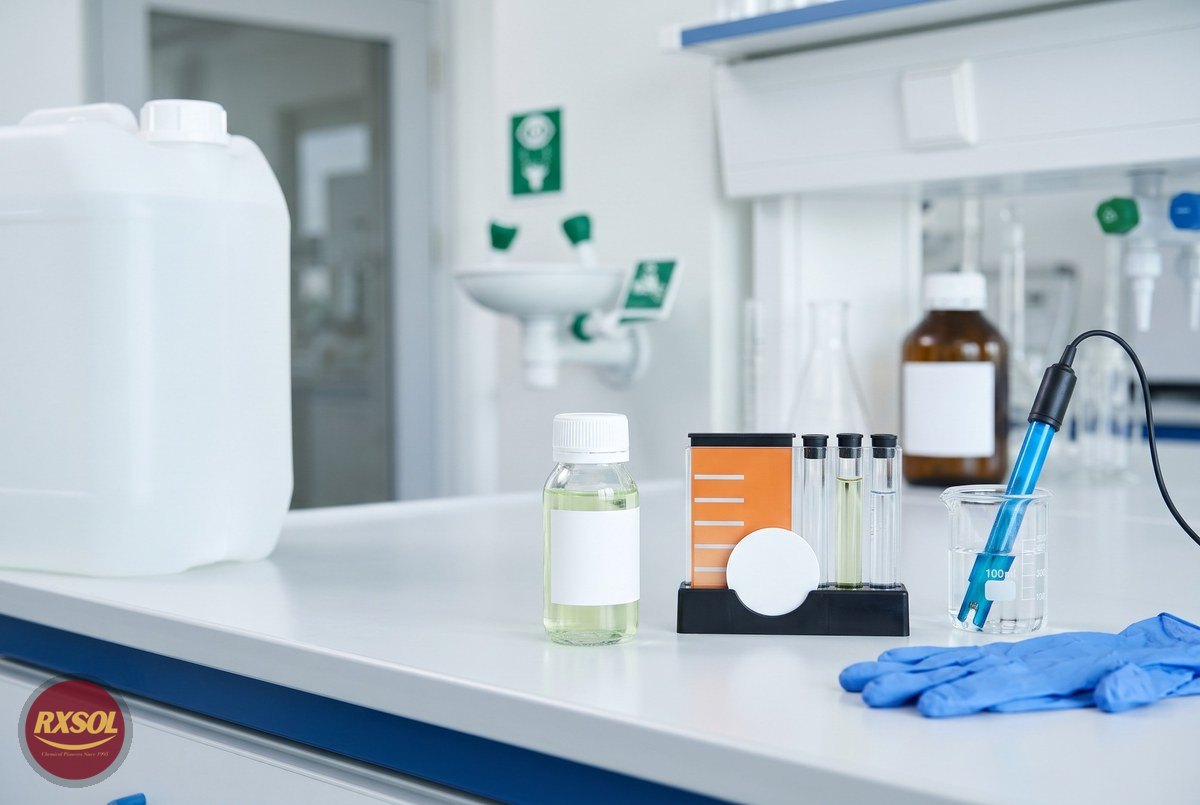
Hotel kitchens and fish processing plants in Salalah need a sanitiser that kills spoilage bacteria on boards, knives, trays and totes, and sodium hypochlorite for food areas is the standard choice. You buy it as a 12 to 15% stock solution, dilute it to 50 to 200 ppm available chlorine, and apply it to surfaces that are already clean. We supply it from our Barka warehouse for delivery to Salalah and the rest of Dhofar, with the MSDS on request.
What sodium hypochlorite is and which grade suits food areas
Sodium hypochlorite (NaOCl) is the liquid form of hypochlorite chlorine, and hypochlorites are the most active of the chlorine compounds used in food plants. It is a pale greenish-yellow liquid with a chlorine odour that mixes with water in any proportion.
Strength decides the grade. Household bleach is about 3 to 8% available chlorine, commercial product about 10 to 12.5%, and technical grade about 12.5 to 15%, sometimes with stabilisers added to slow breakdown. Food grade sodium hypochlorite is a plain solution with no fragrance, stabiliser or thickener, typically around 10 to 12.5% available chlorine and with a lower heavy-metal content.
For a hotel purchasing team, keep scented household bleach out of food areas and buy a plain hypochlorite for anything that touches food. Our extra pure sodium hypochlorite, part number RXSOL-31-3025-025, is a 12.5% wt solution with a specification range of 12.5 - 13.2% NaOCl and 143 - 153 grams/liter of available chlorine. We also offer grades from 3% to 15% available chlorine to a client specification. Ask for the MSDS with your quote and check the grade against your food safety plan before first use.
Where Salalah hotels and fish plants use it
Resorts on the Salalah coast run at full capacity in khareef season, and kitchen hygiene has to keep pace with banquet volumes. Hotel teams use chlorine sanitiser on cutting boards and knives, salad and fruit preparation sinks, walk-in chiller shelves, and buffet and banquet stations once they have been cleaned. The rest of our kitchen and housekeeping range sits in the hotel and catering chemicals category.
Fish plants around Salalah port and Raysut carry a heavier load: slime, blood and scales on filleting tables, conveyors, knives, plastic trays and fish totes. In seafood processing, hypochlorite controls psychrotrophic spoilage bacteria, the cold-tolerant organisms that grow on chilled fish. The same stock also serves fruit and vegetable washing, clean-in-place (CIP) circuits, beverage line sanitation, and process and cooling water.
Dilution table: sodium hypochlorite for food contact surfaces
A 12.5% solution holds 125,000 ppm. The standard worked example is 40 ml of 12.5% sodium hypochlorite in 100 litres of water, which gives about 50 ppm. We calculated the table below on that same 12.5% basis so your staff can dose a bucket, a sink or a 1,000 litre tank without working it out each time.
| Target strength | Typical use | 10 L bucket | 100 L sink or tank | 1,000 L tank |
|---|---|---|---|---|
| 10 ppm | Fish processing water and ice (upper guide value) | 0.8 ml | 8 ml | 80 ml |
| 50 ppm | Immersion of knives, trays and small parts | 4 ml | 40 ml | 400 ml |
| 100 ppm | Spray or wipe on fish-contact and kitchen surfaces | 8 ml | 80 ml | 800 ml |
| 200 ppm | Upper limit for no-rinse food contact sanitising | 16 ml | 160 ml | 1,600 ml |
Our specification gives a typical 150 grams/liter of available chlorine, so a fresh can makes a slightly stronger solution than the table shows, and older stock makes a weaker one. Check every batch with a free available chlorine test strip and adjust. For 10 ppm, dilute into a larger volume or use a measuring syringe, because 0.8 ml is too small to pour accurately.
Clean first, then sanitise: pH, contact time and testing
Fat and protein left on a surface use up chlorine before it reaches the bacteria, so wash and rinse first, then sanitise. Rinse off alkaline detergent as well, because high pH lowers chlorine activity. Chlorine solutions work best at pH 6.5 to 7.0. Near pH 4 they are most active but very unstable, and they can release toxic chlorine gas, so never add acid to a sanitiser bucket.
Up to 200 ppm, no rinse is needed. Above 200 ppm, rinse with clean water after a few minutes. Do not leave chlorine solution on equipment for more than 30 minutes, or it may corrode. Higher strengths are not recommended because of corrosion and worker-health risk, so keep stainless tables, aluminium trays and conveyor parts inside the 50 to 200 ppm range.
Test the working solution with free available chlorine test strips, colour discs, titration kits or colorimeters. Typical fish plant practice is about 50 ppm for immersion and 100 ppm for spray or wipe on fish-contact surfaces, checked before processing and at least every 4 hours during processing, with each reading recorded. A log with the time, reading, initials and any correction is the kind of record HACCP audits look for at export fish plants and hotel kitchens in Oman.
Chlorine in fish processing water and ice
Water and ice that touch fish take far less chlorine than a surface sanitiser. Codex-linked guidance used by some national authorities treats up to 10 mg/L active chlorine in fish processing water and ice that contacts seafood as safe. Older FAO/WHO text suggests about 10 ppm in normal use and about 100 ppm for clean-up.
Research on seafood plants recommends chlorinating process water to about 10 ppm with at least 5 minutes of contact to control Listeria. If your Salalah plant packs for export, confirm the limit your buyer and the Omani authorities apply, then dose your header tank from the 10 ppm row of the table and test at the outlet.
Storage and safety in Dhofar heat and khareef humidity
Hypochlorite solutions are not stable. They slowly break down into salt, chlorate and oxygen, and heat and light speed this up. Typical shelf life for 12.5% class product is about 3 months from manufacture, and strength drops with time and temperature, so Salalah summer heat and the long road from Barka both work against you.
Our label says: Store in cool place. We recommend black containers kept away from exposure to sunlight. Typical guidance is a cool, shaded, ventilated store, the original vented container, ideally below about 21 °C, and bulk storage below 30 °C in HDPE or rubber-lined carbon steel tanks. For your store this means smaller lots ordered more often, first in, first out rotation, and a strength test on every delivery when it arrives.
The undiluted product is classed Danger: it causes severe skin burns and eye damage (H314), may be corrosive to metals (H290) and is very toxic to aquatic life (H400/H411). Contact with acids liberates toxic gases. Wear chemical-resistant gloves, safety goggles or a face shield, and a protective apron when you decant or dilute it.
Never mix it with acids, which release chlorine gas, or with ammonia, which forms chloramine gas. In a hotel the risk sits in the dishwashing area, where acid descalers and ammonia cleaners often share a shelf with bleach. Do not mix with reducing agents, and keep it away from hydrogen peroxide, organics and metals such as copper, nickel, iron, aluminium and zinc. After contact with skin, wash immediately with plenty of water. Empty containers can still be hazardous because they hold product residue.
Where to buy sodium hypochlorite in Salalah and Dhofar
Salalah Chemical (RXSOL group, Oman) holds sodium hypochlorite at our Barka warehouse and delivers to Salalah and Dhofar. Ship agents supplying vessels at Salalah port can order our sodium hypochlorite 12-15 for ship galleys, IMPA 550960. Our sodium hypochlorite 12-15, part number RXSOL-31-3025-005, is also listed on muscatchemical.com and on soharchemical.com.
| Part number | RXSOL-31-3025-025 (extra pure), RXSOL-31-3025-020 (IMPA 550960, marine and galley), RXSOL-31-3025-005 |
|---|---|
| Application | Disinfectant and germicide: food and beverage processing, potable water treatment, wastewater treatment, cooling towers, pools, odour control |
| Dosage | Food contact surfaces: 50 to 200 ppm available chlorine (typical for this product class). For disinfection and bleaching, a weak solution (1.2 %) is used. For purifying water 0.02 to 0.2 % volumetric is sufficient |
| Packing | RXSOL-31-3025-025: 18 / 20 / 25 / 35 / 250 Kg. RXSOL-31-3025-020: 20, 25, 50, 210 Ltrs. RXSOL-31-3025-005: 30, 60, 220 Kgs |
| Technical specs | NaOCl 12.5 - 13.2 %wt (typical 13.0); available chlorine 11.9 - 12.6 %wt (typical 12.4), 143 - 153 grams/liter (typical 150); excess caustic 0.25 - 0.80 %wt; specific gravity @ 60°F 1.197 - 1.220; pH 12.0 - 13.0 |
| Transport | UN 1791, IMDG Class 8, Packing Group III |
| MSDS | On request |
Call +968 77333599 or message us on WhatsApp with the strength, pack size and quantity, and tell us whether the delivery point is a hotel in Salalah, a plant in the free zone or a fish plant near Raysut.
Frequently asked questions
Is sodium hypochlorite safe to use on food contact surfaces?
Yes, when you dilute it to 50 to 200 ppm available chlorine and apply it to a surface that is already clean. Up to 200 ppm no rinse is needed; above 200 ppm, rinse with clean water after a few minutes. Use a plain grade with no fragrance or thickener, and never put the undiluted product on food surfaces.
How much 12.5% sodium hypochlorite do I add to water to make 50, 100 or 200 ppm?
Per 10 litres of water, add 4 ml for 50 ppm, 8 ml for 100 ppm and 16 ml for 200 ppm. Per 100 litres, add 40 ml, 80 ml and 160 ml. Confirm the result with a free available chlorine test strip, because stock strength changes with age.
What is the difference between food grade and technical grade sodium hypochlorite?
Food grade is a plain solution without fragrances, stabilisers or thickeners, typically about 10 to 12.5% available chlorine with a lower heavy-metal content. Technical grade runs about 12.5 to 15% and may contain stabilisers. Ask us for the MSDS of the lot you are buying and match it to your food safety plan.
Where can I buy sodium hypochlorite in Salalah or Dhofar?
From Salalah Chemical (RXSOL group, Oman). We deliver from our Barka warehouse to Salalah and Dhofar. Call +968 77333599 or send a WhatsApp message to the same number.
Request a quote on WhatsApp at +968 77333599 with the strength, pack size and delivery point, or send your requirement through our quote request page.
Frequently asked questions
Is sodium hypochlorite safe to use on food contact surfaces?
Yes, when you dilute it to 50 to 200 ppm available chlorine and apply it to a surface that is already clean. Up to 200 ppm no rinse is needed; above 200 ppm, rinse with clean water after a few minutes. Use a plain grade with no fragrance or thickener, and never put the undiluted product on food surfaces.
How much 12.5% sodium hypochlorite do I add to water to make 50, 100 or 200 ppm?
Per 10 litres of water, add 4 ml for 50 ppm, 8 ml for 100 ppm and 16 ml for 200 ppm. Per 100 litres, add 40 ml, 80 ml and 160 ml. Confirm the result with a free available chlorine test strip, because stock strength changes with age.
What is the difference between food grade and technical grade sodium hypochlorite?
Food grade is a plain solution without fragrances, stabilisers or thickeners, typically about 10 to 12.5% available chlorine with a lower heavy-metal content. Technical grade runs about 12.5 to 15% and may contain stabilisers. Ask us for the MSDS of the lot you are buying and match it to your food safety plan.
Where can I buy sodium hypochlorite in Salalah or Dhofar?
From Salalah Chemical (RXSOL group, Oman). We deliver from our Barka warehouse to Salalah and Dhofar. Call +968 77333599 or send a WhatsApp message to the same number.