
Water Glass Sodium Silicate Oman Supply: Salalah Grades and Uses
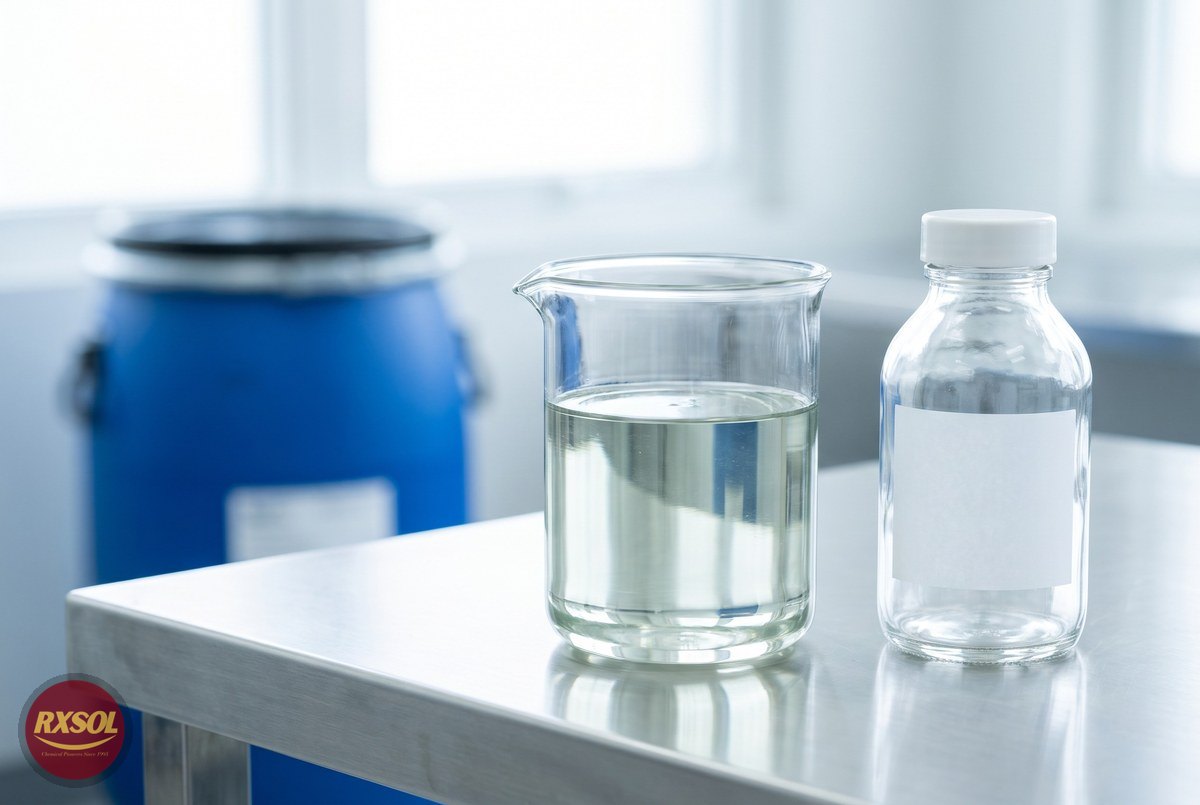
If your Dhofar well needs shale control, your slab needs a hardener or your plant needs a detergent base, order liquid sodium silicate, which is sold as water glass. For water glass sodium silicate Oman buyers in Salalah and across the south, we supply neutral and alkaline grades in 280 kg drums. Packs of 5, 10, 20, 30 and 60 kg are available on request, and we deliver from our Barka warehouse. Choose the grade by its SiO2:Na2O ratio, because the ratio decides how the product behaves in your mud, concrete or process.
What water glass sodium silicate is
Water glass is the common name for clear water solutions of sodium silicate. Its general composition is (Na2O)x·(SiO2)y, and it is registered as CAS 1344-09-8 and EC 215-687-4. Sodium silicate and water glass are the same chemical. 'Water glass' usually means the liquid, while 'sodium silicate' also covers the powder and the glass lumps.
It is made in one of two ways. Silica sand and soda ash (sodium carbonate) are fused at above about 1100 °C and the glass is dissolved in water, or a hydrothermal process dissolves silica in caustic soda. The solutions are strongly alkaline. Our grades are water white, fully transparent liquids. If your process works to a fixed ratio and solids content, we can supply sodium silicate to your own specification.
Alkaline and neutral grades: reading the SiO2:Na2O ratio
The SiO2:Na2O ratio of commercial sodium silicate ranges from about 1:2 to 3.75:1. Grades with a weight ratio below 2.85:1 are called alkaline grade sodium silicate. Grades with a higher ratio are called neutral grade sodium silicate. Lower-ratio grades carry more alkali and are denser. Higher-ratio grades carry more silica for each unit of sodium.
Some certificates of analysis give the weight ratio and others give the molar ratio, also called the modulus, so two offers can be hard to compare. To convert, multiply the weight ratio by 1.032. A weight ratio of 3.22 is therefore a molar ratio of about 3.32. Before you compare figures, ask any supplier, including us, which ratio their COA states.
The table below sets typical ranges for this class of product beside the data from our own product records. The typical figures describe this type of product in general. They are not measured results for a particular batch.
| Item | Detail |
|---|---|
| Part numbers | RXSOL-81-8107-280 (drilling fluids and oil field chemicals), RXSOL-67-8107-280 (construction chemicals) |
| Grades we supply | Sodium silicate liquid, neutral and alkaline, water white |
| Identification | CAS 1344-09-8, EINECS 215-687-4, HS code 2839.19 |
| Typical alkaline liquid (class) | About 40 to 54% concentration, mole ratio about 2.1 to 2.6 |
| Typical neutral liquid (class) | About 27 to 39% concentration, mole ratio about 3.0 to 3.5. A common neutral grade has a weight ratio of about 3.22, about 40 °Bé and pH about 11.3 |
| Typical density (class) | About 1.32 to 1.60 g/cm3, higher for lower-modulus grades |
| COA parameters to check | Appearance, modulus, Na2O, SiO2, solids content, Baumé density, iron, water insolubles, pH and viscosity |
| Test method on our record | Na2O by titrating a diluted sample against HCl with methyl red indicator, then SiO2 by a second titration after adding sodium fluoride |
| Application | Oil field use, concrete hardener and acid-proofing, water treatment, detergent builder, peroxide stabiliser for textile and pulp bleaching, ceramic deflocculant, flux binder for welding rods, silica gel production, timber treatment, fireproofing |
| Dosage | Set for each application by your engineer or a lab trial. No single dose suits every use |
| Packing | 280 kg drum. 5, 10, 20, 30 and 60 kg packing on request |
| MSDS | On request |
Silicate mud drilling fluid for shale inhibition in Dhofar wells
Silicate muds are water-based drilling fluids that inhibit shale. The polymeric silicate ions adsorb onto the shale and form a semipermeable osmotic membrane, which limits how much water and how many ions move into the rock. The wellbore is more stable and the hole stays in gauge through shale sections that might otherwise need a non-aqueous fluid.
A typical silicate mud is a low-solids KCl/polymer system with soluble sodium or potassium silicate added. The silicate protects shale in two ways: it gels in place, and it precipitates when it meets divalent ions. It also stabilises chalk by reacting with Ca2+. In biopolymer-silicate fluids, the silicate also cuts fluid loss and strengthens the borehole wall by forming silica gel in the pores of the rock.
Calcium is the main risk. Drilling through anhydrite can lower the silicate concentration in the mud and change its rheology and filtration. Your mud engineer should find the critical calcium concentration by lab testing before that interval is drilled. The silicate concentration of the system is also set in the lab: run a pilot test on your make-up water and formation samples with the exact grade you plan to order. Our full range of drilling fluids and oil field chemicals for Salalah covers the other additives in the same mud system. The oil field grade is listed as sodium silicate water glass RXSOL-81-8107-280.
Other uses in southern Oman: concrete, water treatment and detergents
Sodium silicate works as a concrete hardener because the liquid reacts with calcium hydroxide in the concrete to form calcium silicate hydrate, which densifies the surface. It is also used for dustproofing, acid-proofing, soil stabilisation, binding foundry sand by the CO2 process, fireproofing and timber treatment. For construction work in Dhofar, order the construction grade sodium silicate water glass RXSOL-67-8107-280.
In water treatment, sodium silicate is used as a coagulant and flocculant aid in wastewater. There are grades certified to NSF/ANSI 60 for drinking water, with a typical maximum use dose of 265 mg/L. If your Salalah plant will dose drinking water, tell us in your enquiry so that we can confirm the grade and documents before you order.
Detergent makers use sodium silicate as a builder and corrosion inhibitor. That makes it a base for alkaline cleaners. Petroleum processing uses it to break emulsions and prevent corrosion. Textile and pulp plants use it to stabilise peroxide in bleaching.
Storage and safe handling in Salalah's climate
Store liquid sodium silicate above 0 °C in closed steel, plastic or stainless steel containers. Never use aluminium, galvanised iron or zinc tanks or fittings, because the solution reacts with aluminium and zinc and releases flammable hydrogen gas. Keep lids tightly closed: carbon dioxide in the air reacts with the liquid and forms skins and deposits in the drum. Keep any powder or solid grade dry during the khareef months, and store every grade away from strong acids.
Sodium silicate solution (25 to 50%) is not combustible and is a medium-strong base. Mist or aerosol irritates the eyes, skin and respiratory tract. Repeated or prolonged exposure to spray mist may produce respiratory tract irritation. Some higher-alkalinity liquid grades are classified as Skin Corrosion Category 1 under GHS, so check the SDS for the grade you receive.
Avoid creating mist, work with ventilation, and wear protective gloves and a face shield. First aid: rinse skin with plenty of water for at least 15 minutes. Rinse eyes for several minutes and get medical attention. If swallowed, rinse the mouth and do not induce vomiting. For spills, collect the liquid in sealable containers and absorb the rest in sand or an inert absorbent.
Water glass sodium silicate Oman supply: where to buy in Salalah
Salalah Chemical (RXSOL group, Oman) supplies sodium silicate from our Barka warehouse and delivers to Salalah and Dhofar. Call +968 77333599, message us on WhatsApp +968 77333599 or email muscatchem@gmail.com. Send us the grade (alkaline or neutral), your limits for ratio, Na2O, SiO2 and Baumé, the quantity and the delivery point. We will send a quote with the MSDS. For import paperwork, sodium silicate comes under HS code 2839.19.
If your project also has sites in the north, our Sohar site lists the same product. Procurement teams based in the capital can order through our Muscat sodium silicate page. You can also browse all the chemicals we deliver to Salalah and combine items in one shipment.
Frequently asked questions
What is the difference between water glass and sodium silicate?
They are the same chemical, CAS 1344-09-8. Water glass is the common name for the clear liquid solution. Sodium silicate also covers the powder and glass lump forms.
What is the difference between alkaline and neutral grade sodium silicate?
Grades with a SiO2:Na2O weight ratio below 2.85:1 are alkaline, and grades with a higher ratio are neutral. Alkaline grades carry more sodium oxide and are denser. Neutral grades carry more silica. We supply both.
Does calcium or anhydrite affect a silicate mud?
Yes. Drilling through anhydrite can lower the silicate concentration and change the rheology and filtration of the mud. Find the critical calcium concentration by lab testing before you drill that section.
Why must sodium silicate not be stored in aluminium or galvanised tanks?
The solution reacts with aluminium and zinc and releases flammable hydrogen gas. Use closed steel, plastic or stainless steel containers.
Where can I buy sodium silicate in Salalah?
Order from Salalah Chemical on +968 77333599 or on WhatsApp. We supply 280 kg drums, and 5 to 60 kg packs on request, delivered from Barka to Salalah and Dhofar.
To order alkaline or neutral sodium silicate for your Salalah site, request a quote or send your grade and quantity on WhatsApp +968 77333599.
Frequently asked questions
What is the difference between water glass and sodium silicate?
They are the same chemical, CAS 1344-09-8. Water glass is the common name for the clear liquid solution. Sodium silicate also covers the powder and glass lump forms.
What is the difference between alkaline and neutral grade sodium silicate?
Grades with a SiO2:Na2O weight ratio below 2.85:1 are alkaline, and grades with a higher ratio are neutral. Alkaline grades carry more sodium oxide and are denser. Neutral grades carry more silica. We supply both.
Does calcium or anhydrite affect a silicate mud?
Yes. Drilling through anhydrite can lower the silicate concentration and change the rheology and filtration of the mud. Find the critical calcium concentration by lab testing before you drill that section.
Why must sodium silicate not be stored in aluminium or galvanised tanks?
The solution reacts with aluminium and zinc and releases flammable hydrogen gas. Use closed steel, plastic or stainless steel containers.
Where can I buy sodium silicate in Salalah?
Order from Salalah Chemical on +968 77333599 or on WhatsApp. We supply 280 kg drums, and 5 to 60 kg packs on request, delivered from Barka to Salalah and Dhofar.