
CTC Cleaner Oman: Engine Room and Tank Cleaning at Salalah Port
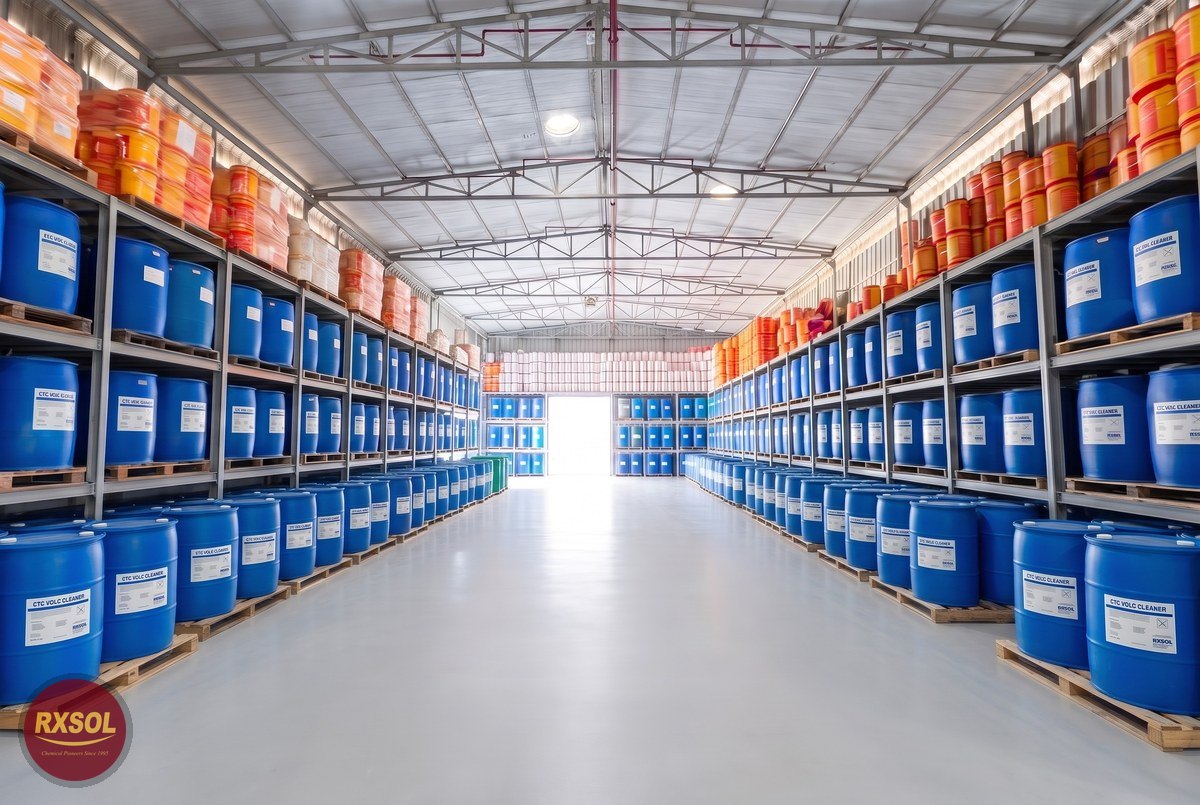
Engine rooms and tanks on ships calling at Salalah port build up oil, sludge and carbon that ordinary detergents leave behind, and CTC Volc Cleaner is a concentrate made to remove them. If you are buying CTC cleaner Oman stock for a vessel, a Free Zone plant or a fish oil tank in Dhofar, here is what you need to know. Dilute it to 0.2 to 0.4% in water. Apply it by spraying, by recirculation or by injection into the Butterworth system. Order it in 20 L or 210 L packs from our Barka warehouse for delivery to Salalah.
What a CTC cleaner is and how the concentrate works
A CTC-type cleaner is a highly concentrated, water-soluble tank cleaning concentrate and emulsifier. Products of this class are made from biodegradable surfactants, complexing agents and additives. Their biodegradability is typically above 90%, and they contain no hydrocarbon solvents. They lift hydrocarbons and chemical residues from cargo, storage and process tanks.
Our CTC Volc Cleaner is a water-based, low toxic, non-flammable tank cleaner and emulsifier with wetting agents. It removes grease, oil, carbon deposits, soil, grime, waxes, sludge and soot, and keeps the loosened deposits in suspension so they do not settle back on the steel. It also works for gas freeing, hydrocarbon freeing and deodorising tanks, and it acts as an acid-neutralising agent. The CTC Volc Cleaner 20 Ltrs pack (RXSOL-20-2028-020) is a convenient size for smaller jobs.
Where it is used: cargo tanks, storage tanks and Salalah Free Zone plants
In cargo and storage tanks it removes lube oils, gas oil, kerosene, mineral oil products, phthalates, paraffins, vegetable oils and odour-intensive products. It also softens baked-on drying oils such as linseed, tung and castor oil.
The product is also used ashore around Salalah. Dhofar fisheries and cold stores deal with fish oil, marine oil residues, tallow and animal fats, and the CTC Volc grade is listed for all of these residues. Plants in the Salalah Free Zone can use it to degrease and deodorise storage tanks.
For heavy black oil and furnace carbon, our solvent-based Tank Cleaner HD (RXSOL-20-2001-020) is the better match. It has a flash point (PMCC) above 62 °C and may swell rubber, so it is meant for different jobs from the water-based CTC grade.
Dosage and method: spraying, recirculation and Butterworth injection
CTC Volc Cleaner is used at 0.2 to 0.4% in water. That works out at about 20 to 40 kg of product per 10 m³ of wash solution. Standard tank cleaners typically need 2 to 5%, or 200 to 500 kg for the same 10 m³, so you need far fewer drums for one wash.
Some procedure sheets give a figure of 2.5%. That figure is for a recirculation solution made with caustic soda flakes in fresh water heated to about 50 °C, where 2.5 to 4.5% is reported as sufficient. This is a caustic-boosted wash and is separate from the normal concentrate dose. For routine tank washing, stay with 0.2 to 0.4% in water.
- Flush the tank or system with cold water first. This limits evaporation and polymerisation of the residue.
- Direct injection and recirculation: inject the product at 0.2 to 0.4% into the wash water and recirculate it with tank cleaning machines. Our product record gives direct injection followed by recirculation washing as the most economical way to use the concentrate.
- Spraying: spray CTC Volc Cleaner undiluted, straight from the drum, onto areas where residue remains after rough washing. Leave it for 10 to 45 minutes, but do not allow it to dry. Then Butterworth at maximum pressure with warm water at 60 °C for at least 3 hours, checking that no foam remains in the final stages.
- Inspect the tank. If it is clean, rinse with fresh water and dry.
The typical cleaning temperature for this class is 10 to 80 °C, and it works in both fresh water and sea water. A ship at Salalah anchorage can therefore run the Butterworth system on sea water when fresh water is short.
If a residue needs extra help, products of this class can be boosted with sodium or potassium hydroxide or alkaline cleaners, or with citric, phosphoric or nitric acid or acid cleaners. Choose either an alkaline boost or an acid boost for each wash. Too much caustic or too high a temperature can leave a white powder residue in the tank. Use a strainer at the pump stack when circulating any solution.
Typical specs, tank coatings and metals
| Item | Detail |
|---|---|
| Part numbers | RXSOL-20-2028-020 (20 Ltrs), RXSOL-20-2028-025 (25 Ltr), RXSOL-20-2028-210 (210 Ltr) |
| Product type | Water-based tank and industrial cleaner, emulsifier |
| Application | Lube oils, gas oil, kerosene, mineral oil products, phthalates, paraffins, vegetable, animal and fish oils, tank cleaning |
| Dosage | 0.2 to 0.4% in water |
| Appearance (typical for this class) | Yellow viscous liquid, may show 2 phases |
| pH (typical) | Approx. 7 (neutral) |
| Specific gravity (typical) | Approx. 1.0 |
| Solubility and foam | Completely soluble in water, low foam |
| Flammability | Non-flammable |
| Cleaning temperature (typical) | 10 to 80 °C, fresh or sea water |
| Storage temperature (typical) | -5 to 30 °C |
| Packing | 20 L, 25 L, 50 L and 210 L; 220 kg drum also listed |
| Safety data | Consult the Safety Data Sheet before use |
Products of this class are safe on stainless steel and resistant coatings, and are listed as suitable for epoxy, phenolic and zinc coatings. Our product record also states that the grade is non-corrosive to ferrous metals. Check your coating maker's resistance list before the first wash, particularly in a coated cargo tank.
Bilge washings, safety, storage and IMO rules
After degreasing, let the bilge slop settle for at least 3 hours before it passes through the oily water separator, so the separator does not receive a fresh emulsion. Record bilge transfers and discharges in your Oil Record Book under MARPOL Annex I.
Tank cleaning additives used on ships are assessed under IMO guidance. MEPC.1/Circ.590 was revoked and replaced by MEPC.1/Circ.590/Rev.1 on 13 November 2024. Approved products are listed in the annex to the MEPC.2 circular. If your charterer or terminal asks for a listed additive for cargo tank washing, ask us to confirm the status of this grade before you order.
Hazard: causes serious eye damage. Wear eye protection and consult the Safety Data Sheet before use. On deck or in the engine room, that means goggles, chemical-resistant gloves and an eyewash point near where you mix the solution. Products of this class are typically not classed as dangerous goods for handling, transport and storage by land, sea or air. Confirm this against the SDS for the grade you buy.
Typical storage temperature is -5 to 30 °C. A drum left on a sunlit quay in Salalah can go above that limit, so keep stock in a shaded, ventilated store. Arrange disposal of used wash water ashore with the port reception facility or a licensed waste contractor.
Where to buy CTC cleaner Oman stock in Salalah and Dhofar
Salalah Chemical (RXSOL group, Oman) supplies CTC Volc Cleaner from our Barka warehouse and delivers to Salalah and Dhofar. We pack it in 20 L, 25 L, 50 L and 210 L. Order the 210 litre CTC Volc Cleaner drum (RXSOL-20-2028-210) for a full tank cleaning programme and 20 L packs for smaller jobs. You can compare it with the other grades in our tank cleaner range.
For vessels calling at northern ports, the same CTC Volc Cleaner 20 Ltrs is also listed by Sohar Chemical. Buyers in the capital can order the 20 litre pack through Muscat Chemical.
Call +968 77333599 or email muscatchem@gmail.com. Send the part number, pack size and quantity, plus either the vessel name with berth or ETA at Port of Salalah, or your plant address in the Free Zone. We will confirm availability and delivery.
Frequently asked questions
What is a CTC cleaner used for on ships?
It is a water-based tank cleaning concentrate and emulsifier. Crews use it to clean cargo and storage tanks that have held lube oil, gas oil, or vegetable, animal or fish oils.
How much CTC tank cleaner do I mix with water?
Use 0.2 to 0.4% in water, which is about 20 to 40 kg per 10 m³ of wash solution. For spraying, apply it undiluted and leave it for 10 to 45 minutes without letting it dry.
Can it be used with seawater?
Yes. Cleaners of this class typically work in both fresh water and sea water at 10 to 80 °C. The caustic-boosted recirculation wash is made up in fresh water.
Is CTC cleaner flammable or dangerous goods?
Our CTC Volc Cleaner is non-flammable. Products of this class are typically not classed as dangerous goods, but they cause serious eye damage, so wear eye protection and read the SDS.
Where can I buy CTC cleaner in 20 litre packs in Salalah?
Order from Salalah Chemical on +968 77333599. We deliver from our Barka warehouse to Salalah and across Dhofar.
Request a quote on WhatsApp at +968 77333599 with your pack size, quantity and delivery point in Salalah, or use our quote request form.
Frequently asked questions
What is a CTC cleaner used for on ships?
It is a water-based tank cleaning concentrate and emulsifier. Crews use it to clean cargo and storage tanks that have held lube oil, gas oil, or vegetable, animal or fish oils.
How much CTC tank cleaner do I mix with water?
Use 0.2 to 0.4% in water, which is about 20 to 40 kg per 10 m³ of wash solution. For spraying, apply it undiluted and leave it for 10 to 45 minutes without letting it dry.
Can it be used with seawater?
Yes. Cleaners of this class typically work in both fresh water and sea water at 10 to 80 °C. The caustic-boosted recirculation wash is made up in fresh water.
Is CTC cleaner flammable or dangerous goods?
Our CTC Volc Cleaner is non-flammable. Products of this class are typically not classed as dangerous goods, but they cause serious eye damage, so wear eye protection and read the SDS.
Where can I buy CTC cleaner in 20 litre packs in Salalah?
Order from Salalah Chemical on +968 77333599. We deliver from our Barka warehouse to Salalah and across Dhofar.