
Lithium Hydroxide for Absorption Chillers: A Salalah Plant Guide
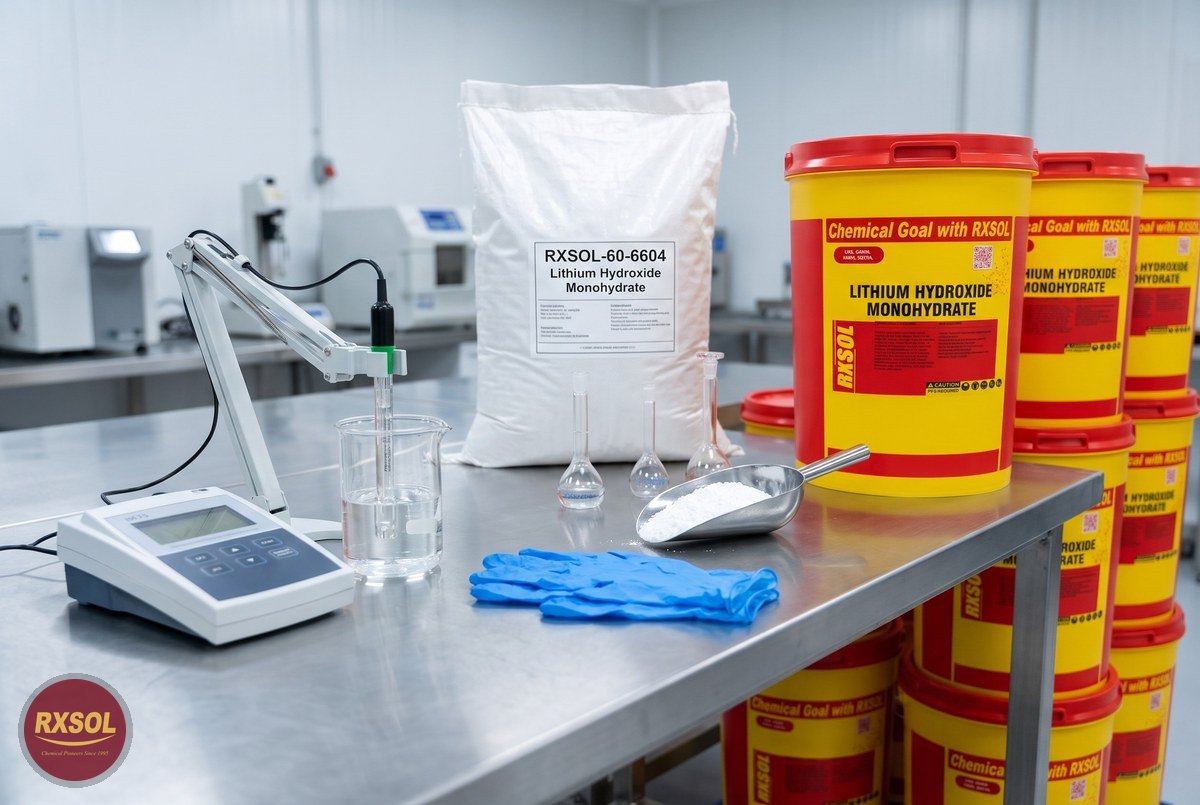
If the lithium bromide solution in your absorption chiller is attacking steel or copper, check the lithium hydroxide first. Lithium hydroxide for absorption chillers is the main corrosion inhibitor in LiBr solution. It typically holds the pH between 11 and 13 and sets the alkalinity that protects the shell, tubes and heat exchangers. Order it as lithium hydroxide monohydrate, test the solution on a regular schedule, and keep the powder sealed against Salalah's humidity.
Why LiBr Absorption Chillers Need Lithium Hydroxide
A lithium bromide absorption chiller uses a strong salt solution, typically around 54% LiBr, to absorb water vapour. At about 50% concentration, lithium bromide is highly corrosive to mild steel. Oxygen that enters through an air leak feeds the corrosion reaction, so a continuous leak raises the corrosion rate for as long as it stays open.
Lithium hydroxide is the primary inhibitor in most LiBr charges. A typical charged solution carries approximately 0.2% by weight LiOH. Even with LiOH present, the machine can still generate hydrogen. For that reason most inhibitor packages add a second chemical: a nitrate or a molybdate, or a chromate on older machines.
How Lithium Hydroxide for Absorption Chillers Controls Corrosion
Alkalinity has to be balanced. When pH and alkalinity are low, steel is attacked and copper is spared. When alkalinity is too high, the reverse happens and copper starts to dissolve. You raise alkalinity with lithium hydroxide and lower it with hydrobromic acid. The right target depends on the inhibitor in your machine.
Typical alkalinity targets are about 0.09N for nitrate-inhibited solutions and about 0.005N for chromate-inhibited solutions. Treat these as typical values only and follow the chiller maker's specification for your unit.
Hydroxide normality tends to rise with use, so many plants have to reduce alkalinity from time to time as well as top it up. There are two ways to do this. The first is dosing hydrobromic acid, which is hazardous and needs exact dilution. The second is bubbling CO2 through the solution. This forms insoluble lithium carbonate particles of about 10 to 15 microns, which are then removed by filtration.
Secondary Inhibitors: Nitrate, Molybdate and Chromate
Lithium nitrate is a common partner for LiOH, but too much of it causes problems. Nitrate forms iron oxide that can flake off and foul orifices, and it is reduced to ammonia, which attacks copper. Lithium molybdate and chromate protect steel without forming ammonia or iron oxide. Chromate is restricted as a pollutant. If chromate disposal is a problem at your Salalah Free Zone plant or hotel plant room, molybdate is the usual chromate-free choice. Ask the chiller maker before you change the inhibitor type in an existing charge.
Solution Testing: What to Measure and How Often
A routine LiBr solution analysis covers:
- Specific gravity or LiBr strength
- Alkalinity and pH, which also show whether air is leaking in
- Dissolved copper, dissolved iron and suspended solids
- Inhibitor level and by-products: nitrate, ammonia, molybdate or chromate
To measure alkalinity, the lab filters the sample through a filter of about 3 microns and titrates it to the phenolphthalein end point with 0.1N acid. The lab report then gives the chemical additions needed to bring the solution back to specification.
New chillers lose inhibitor at a high, predictable rate in their early run hours. Sample more often after commissioning or a recharge, then move to a routine schedule once the results are steady. Use clean, dry, tightly sealed sample bottles and record the run hours with each sample.
Reading the Results
| Result | Likely cause | Usual correction |
|---|---|---|
| Low alkalinity or pH | Inhibitor used up, air getting in, too much acid dosed | Find and fix leaks, add lithium hydroxide in measured steps |
| High alkalinity | Normal rise with use, too much LiOH dosed | Hydrobromic acid at exact dilution, or CO2 treatment and filtration |
| Rising copper | Alkalinity too high, ammonia from nitrate | Bring alkalinity back to target, check the nitrate dose |
| Rising iron or suspended solids | Steel attack at low alkalinity, air leaks, iron oxide flaking | Restore alkalinity and inhibitor, filter the solution |
| Hydrogen or loss of vacuum | Steel corrosion, air leak, low secondary inhibitor | Leak test, purge, restore the secondary inhibitor |
Choosing the Grade: Monohydrate or Anhydrous
Lithium hydroxide is sold as anhydrous LiOH (CAS 1310-65-2) and as lithium hydroxide monohydrate, LiOH·H2O (CAS 1310-66-3, MW 41.96). It is a hygroscopic white crystalline powder and the weakest base among the alkali metal hydroxides. Most chiller sites handle the monohydrate.
The water in the monohydrate changes the weight you need. With 56.5% LiOH content, you need roughly 1.77 kg of monohydrate to supply 1 kg of LiOH. Before you weigh anything, check which form your chiller maker's dosing figure refers to.
For a top-up, low impurity levels matter more than the grade name on the bag. A typical technical-grade monohydrate specification for this product class looks like this:
| Parameter | Typical value |
|---|---|
| Product | Lithium hydroxide monohydrate, LiOH·H2O |
| Application | Alkalinity and corrosion control in LiBr absorption chiller solution |
| LiOH content | 56.5% min |
| Na+K | ≤0.15% |
| Fe | ≤0.002% |
| Ca | ≤0.035% |
| Chloride | ≤0.010% |
| Sulfate | ≤0.020% |
| CO2 | ≤0.50% |
| HCl-insolubles | ≤0.01% |
| Typical market packing | 25 kg bags |
| MSDS | On request |
Grades on the market include industrial, battery and lab or reagent. Ask for the batch specification of any grade you are offered, so your chiller service engineer can compare it with the maker's requirement. If your plant laboratory also needs reagents for the alkalinity titration, see our lab chemical range for Salalah plant laboratories.
Salalah Conditions, Handling and Storage
Dhofar conditions are hard on absorption chillers. Khareef humidity, salt-laden coastal air near Salalah port and high cooling-water temperatures all speed up corrosion in a machine with even a small air leak, and they also degrade stored powder. LiOH reacts with carbon dioxide to form lithium carbonate (2LiOH + CO2 → Li2CO3 + H2O). Keep containers tightly closed and dry so the powder does not lose strength by absorbing CO2 and moisture. Reseal part-used bags straight away and store them off the floor in a dry, shaded room.
Lithium hydroxide is corrosive and causes severe skin burns and eye damage (H314, Skin Corr. 1). Some SDSs also classify it as toxic if swallowed (H301). Follow the SDS for protective equipment when you weigh or handle it. Prepare and charge top-up solution using the chiller maker's procedure so that no air enters the machine, and keep the solution covered so it does not pick up CO2. Lithium hydroxide is transported as UN 2680, Class 8.
Where to Buy Lithium Hydroxide in Salalah and Oman
Salalah Chemical (RXSOL group, Oman) delivers to Salalah and Dhofar from our Barka warehouse. Ask us about lithium hydroxide availability, grade and packing for free zone plants, hotels, port facilities and cold stores. Call +968 77333599 or message us on WhatsApp at +968 77333599 with the quantity, grade and delivery site you need, or use our quote request form for Salalah deliveries. To combine other chemicals in the same delivery to your plant room, check our full Salalah Chemical product list before you send the enquiry.
If your group also runs a plant in the north, our sister site Muscat Chemical lists general lab chemicals such as benzoic acid on its Muscat product page.
FAQs
Why is lithium hydroxide added to lithium bromide absorption chillers?
Lithium bromide solution is highly corrosive to steel. Lithium hydroxide is the primary inhibitor. It raises the pH, typically to between 11 and 13, and sets the alkalinity that slows corrosion of steel parts.
What alkalinity should a LiBr chiller solution have?
Typical targets are about 0.09N for nitrate-inhibited solutions and about 0.005N for chromate-inhibited solutions. Always follow the chiller maker's specification for your machine.
Why does my absorption chiller keep losing vacuum or making hydrogen?
Hydrogen is a non-condensable gas that forms even when LiOH is present. Air leaks add oxygen, which speeds up corrosion. Check for leaks, test the alkalinity and the secondary inhibitor level, and correct both.
Is lithium hydroxide hazardous and how should it be stored?
Yes. It causes severe skin burns and eye damage (H314) and is transported as UN 2680, Class 8. Store it tightly closed in a dry place so it does not absorb CO2 and moisture.
Where can I buy lithium hydroxide monohydrate in Salalah?
We deliver to Salalah and Dhofar from our Barka warehouse. Send your quantity and grade on WhatsApp to +968 77333599 to ask about availability and a quote.
To order lithium hydroxide for your absorption chiller, request a quote on WhatsApp +968 77333599 and tell us your delivery site in Salalah.
Frequently asked questions
Why is lithium hydroxide added to lithium bromide absorption chillers?
Lithium bromide solution is highly corrosive to steel. Lithium hydroxide is the primary inhibitor. It raises the pH, typically to between 11 and 13, and sets the alkalinity that slows corrosion of steel parts.
What alkalinity should a LiBr chiller solution have?
Typical targets are about 0.09N for nitrate-inhibited solutions and about 0.005N for chromate-inhibited solutions. Always follow the chiller maker's specification for your machine.
Why does my absorption chiller keep losing vacuum or making hydrogen?
Hydrogen is a non-condensable gas that forms even when LiOH is present. Air leaks add oxygen, which speeds up corrosion. Check for leaks, test the alkalinity and the secondary inhibitor level, and correct both.
Is lithium hydroxide hazardous and how should it be stored?
Yes. It causes severe skin burns and eye damage (H314) and is transported as UN 2680, Class 8. Store it tightly closed in a dry place so it does not absorb CO2 and moisture.
Where can I buy lithium hydroxide monohydrate in Salalah?
We deliver to Salalah and Dhofar from our Barka warehouse. Send your quantity and grade on WhatsApp to +968 77333599 to ask about availability and a quote.