
Safe Acid Descaler in Oman for Salalah Free Zone Cooling Lines
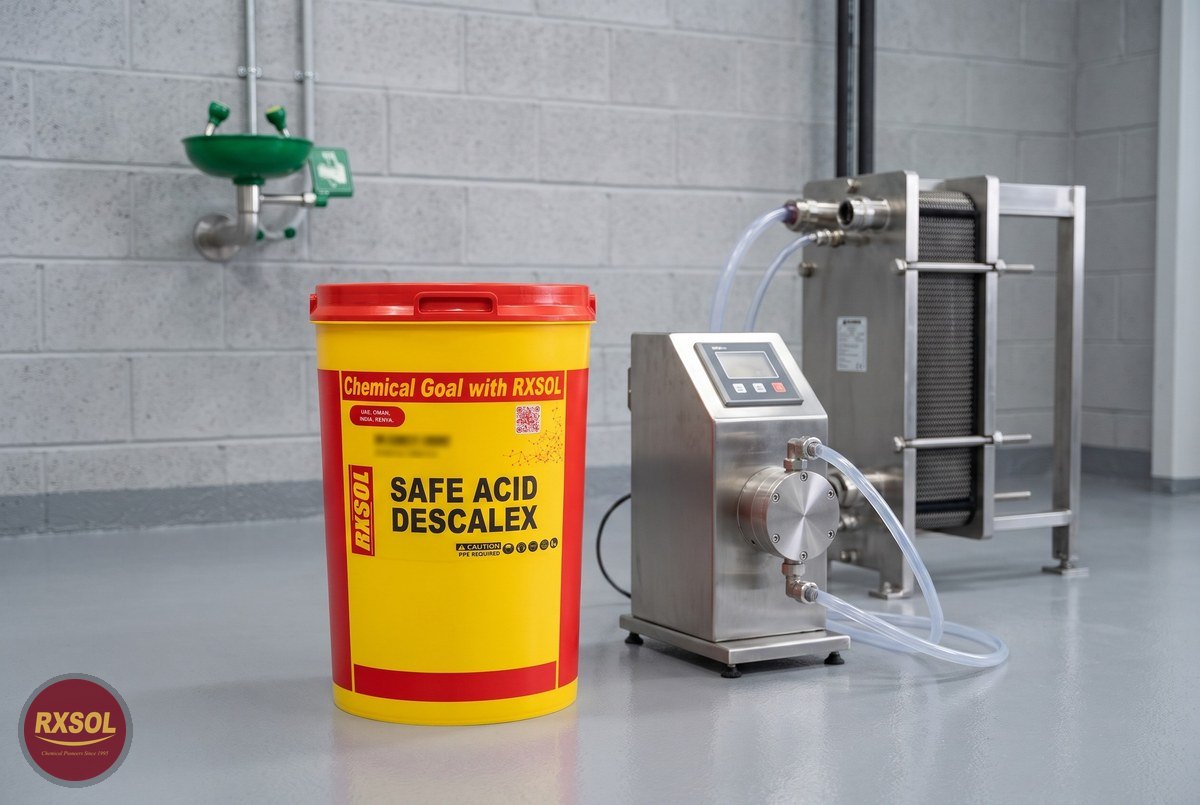
Scale in the cooling lines of a Salalah Free Zone plant cuts heat transfer and raises condenser pressure. The standard fix is a safe acid descaler, which buyers in Oman can get in liquid or powder form. It is an inhibited acid that dissolves calcium carbonate and rust on the water side and protects the metal underneath. We supply two grades from our Barka warehouse to Salalah and Dhofar: Safe Acid Descalex powder (RXSOL-40-1008-020) and Safe Acid Descalex Liquid (RXSOL-54-1048-025). You mix either one with fresh water at 3 to 20 percent, depending on how heavy the scale is. Then you circulate it through the line, drain it, neutralise and rinse.
What a safe acid descaler is and how it differs from plain acid
A safe acid descaler is an inhibited acid blend: an acid plus descaling accelerators, corrosion inhibitors and wetting agents. The acid dissolves mineral scale (mainly calcium carbonate) and rust from the water side of heat-transfer equipment. The inhibitors protect cleaned surfaces from acid attack. The wetting agents carry the solution into narrow plate passages and condenser tubes. Plain hydrochloric acid also dissolves scale, but it has no inhibitor to slow its attack on the metal once the scale is gone.
Our powder grade is a heavy-duty dry acid with accelerators, corrosion inhibitors, wetting agents and an anti-foam agent. Its safety data sheet gives CAS number 5329-14-6 for the acid blend, which is sulfamic acid. Inhibited sulfamic acid powder is generally described as safer to handle than hydrochloric acid. The powder dissolves in water and is non-flammable and non-volatile. It needs no heating unless you want it to work faster.
The liquid grade suits sites that would rather pour and pump than dissolve powder. It does not need heating during cleaning. In concentrated form it can dissolve approximately 1.5kg of calcium carbonate scale per gallon. Some equipment can be cleaned with it while still in operation, using a minimum of your own staff.
| Item | Safe Acid Descalex powder | Safe Acid Descalex Liquid |
|---|---|---|
| Part number | RXSOL-40-1008-020 | RXSOL-54-1048-025 |
| Application | Boilers, calorifiers, heat exchangers, diesel engine cooling systems, condensers, evaporators | Chillers, cooling towers, pipework, condensers, ice machines, refrigeration equipment, heat exchangers |
| Dosage | 3 to 20 percent in fresh water depending on scale deposit | 3 to 20 percent in fresh water depending on scale deposit; 10-30% after degreasing oil-contaminated systems |
| Technical specs | Powder; density 1.2g/cm3; pH (10 wt %): 1.1; colour indicator shows solution strength | No heating needed; approximately 1.5kg calcium carbonate per gallon in concentrated form; non-combustible |
| Metal compatibility | Avoid aluminium, zinc, tin and their alloys. Avoid galvanised surfaces. Rubber: no known effect | Do not use on aluminium surfaces |
| Packing | 5, 10, 20, 25, 50 Kg jar | 25, 50 Ltr packs |
| MSDS | On request | On request |
Why cooling lines scale fast at Salalah Free Zone plants
Cooling water concentrates as it evaporates in the tower. The hardness left behind settles as calcium carbonate on the hottest surfaces: exchanger plates, condenser tubes and compressor jackets. Make-up water from Dhofar wells brings hardness with it. Desalinated make-up water also scales once cycles of concentration drift too high. During the khareef, humid air and sea salt around Salalah port put more load on towers and air-cooled units. An industry rule of thumb is that 1 mm of scale can cut heat transfer by about 20 to 30%.
In the free zone this scale builds up on methanol and ammonia plant exchangers and compressor coolers and in cement plant cooling circuits. Fish processing plants and cold stores see it on chillers, refrigeration condensers and ice machines. Related treatment products are in our cooling water chemical range.
Dilution guide: how much descaler for your system volume
Mix either grade with fresh water at 3 to 20 percent, depending on how much scale has built up. For the liquid, a system that was contaminated with oil and has since been degreased may need a 10-30% solution. Use the low end of the range for light scale and the top end for hard, thick scale. Some formulators advise against circulating anything weaker than 10 to 20%, because inhibitor protection drops. Check the TDS before you mix a weak solution.
First work out how much water the circuit holds: the tower basin or tank, the pipework and the water side of each exchanger. Then multiply by the percentage. A loop holding 2,000 litres cleaned at 10% needs 200 litres of liquid concentrate. That is eight 25 litre packs or four 50 litre packs. Heavy scale can use up the first charge, so keep a spare pack on site.
Step-by-step circulation descaling of a cooling line
Circulation is the most effective method. You can soak small parts, such as strainers, in a plastic or plastic-lined immersion bath instead.
- Isolate the exchanger or loop, drain it and rinse it with water.
- If the system holds oil, grease or sludge, clean it first with our degreaser RXSOL-10-1005, then rinse.
- Remove or bypass any aluminium, zinc, tin or galvanised parts. Compatibility with stainless steel and cast iron varies between formulations, so check these against the TDS.
- Fill a plastic tank with the measured solution and pump it round the line. No heating is needed. If you heat it to speed things up, keep it to a maximum of about 55 to 60°C.
- Check the end point regularly. The contact time is generally within 24 hours, depending on scale thickness.
- Drain, neutralise and rinse. Then passivate and restart with your normal anti-scalant programme.
How to tell when descaling is finished
Our powder grade has a colour indicator that shows solution strength. With this type of indicator, the solution is red while active and turns orange at about 85% acid consumption. It becomes colourless when fully spent. You can add more descaler to bring the colour back, typically no more than twice. With either grade, the acid is still working while you can see light fizzing. When the fizzing stops, the acid has finished working.
Neutralising, flushing and passivating
After draining, thoroughly rinse all metal surfaces at least once with a 0.5% alkaline solution in fresh water. Circulate it for 2-4 hours or until an acceptable pH value is obtained. This neutralises any remaining acidity and passivates steel surfaces. Keep rinsing until pH paper shows neutral. For cooling loops, passivation with sodium nitrite or molybdate is recommended. To stop scale coming back, restart anti-scalant dosing and keep bleed-off and cycles of concentration under control.
Metal compatibility, PPE and disposal
Inhibited descalers of this type are generally suitable for copper, copper-nickel, bronze, brass, iron, steel and rubber. They must not be used on aluminium, zinc, tin or galvanised surfaces. Never flush or descale a system without eye protection and rubber gloves. Gases may be released, so keep the work area well ventilated and avoid naked flames.
HCl-based liquid descalers are typically classed Corrosive to metals Cat. 1 (H290), Skin corrosion Cat. 1A (H314) and STOT SE 3 (H335) for respiratory tract irritation. Ask us for the SDS for the exact grade you order. Collect the spent solution and flush water, neutralise them and keep run-off out of drains. Dispose of them under your site environmental permit, using a licensed waste contractor where required.
Where to buy safe acid descaler in Oman and Salalah
Salalah Chemical (RXSOL group, Oman) supplies both grades from our Barka warehouse and delivers to Salalah and Dhofar. Call +968 77333599, or send a WhatsApp message to the same number. Tell us your system volume, how heavy the scale is and what metals the system contains, and we will advise the grade and quantity. We also supply the liquid grade for deliveries to Sohar port and Batinah and for plants and ships in Muscat. This helps if your company runs sites in both northern and southern Oman. Browse all our products for degreasers to order with it.
FAQs: safe acid descaler in Oman
Liquid or powder descaler: which is better for cooling water systems?
Both clean the same equipment at 3 to 20 percent. The powder is easier to transport and store at remote sites, and it has a colour indicator. The liquid needs no dissolving, so it suits sites that pump straight from the pack.
Is a safe acid descaler safe on copper, stainless steel and aluminium?
This type of descaler is generally suitable for copper, copper-nickel, bronze, brass and steel. Never use it on aluminium, zinc, tin or galvanised surfaces. Whether it suits stainless steel depends on the formulation, so check the TDS first.
Does a liquid acid descaler need to be heated?
No. Our liquid grade does not need heating. If you heat it to speed up the job, keep the solution to a maximum of about 55 to 60°C.
Where can I buy safe acid descaler in Salalah?
Order from Salalah Chemical on +968 77333599 or by WhatsApp. We deliver from our Barka warehouse to Salalah, the free zone and the rest of Dhofar.
To get the right grade and quantity for your cooling lines, request a quote or send your system details on WhatsApp at +968 77333599.
Frequently asked questions
Liquid or powder descaler: which is better for cooling water systems?
Both clean the same equipment at 3 to 20 percent. The powder is easier to transport and store at remote sites, and it has a colour indicator. The liquid needs no dissolving, so it suits sites that pump straight from the pack.
Is a safe acid descaler safe on copper, stainless steel and aluminium?
This type of descaler is generally suitable for copper, copper-nickel, bronze, brass and steel. Never use it on aluminium, zinc, tin or galvanised surfaces. Whether it suits stainless steel depends on the formulation, so check the TDS first.
Does a liquid acid descaler need to be heated?
No. Our liquid grade does not need heating. If you heat it to speed up the job, keep the solution to a maximum of about 55 to 60°C.
Where can I buy safe acid descaler in Salalah?
Order from Salalah Chemical on +968 77333599 or by WhatsApp. We deliver from our Barka warehouse to Salalah, the free zone and the rest of Dhofar.